Written by: Jake Drutchas, Co-founder, CEO, Lodg
Key Takeaways For Lead-To-Lease Automation
-
An AI for answering rental leads responds within seconds, 24/7, across phone, text, email, webchat, and listing sites. That speed captures every inquiry and cuts vacancy days.
-
The complete lead-to-lease workflow captures, qualifies, books tours, briefs agents, follows up, and writes results back to the PMS with minimal human intervention.
-
Integration with AppFolio, Yardi, Rentvine, and similar PMS platforms keeps the system of record intact and removes duplicate data entry.
-
Lodg acts as the AI execution layer that automates this workflow and scales with portfolio size without additional headcount.
How AI For Answering Rental Leads Runs The Lead-To-Lease Workflow
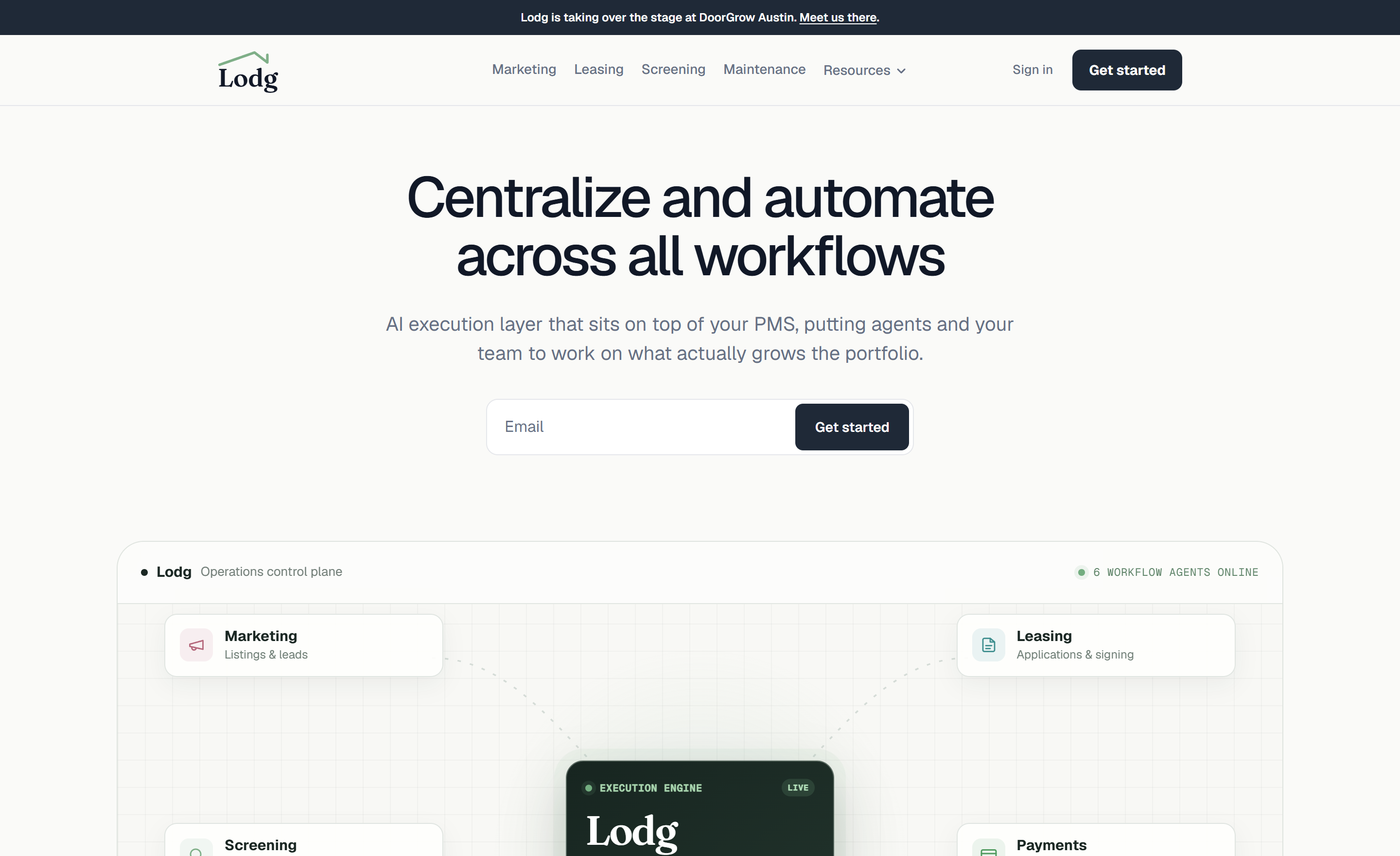
You know the drill. A prospect messages on Saturday night, your leasing agent sees it Monday morning, and by then the prospect has signed somewhere else. A complete AI lead response system executes the full lead-to-lease workflow, not just the first reply. It runs a sequence of steps where each stage passes context to the next. Humans step in only for exceptions and decisions that require judgment.
-
Capture: Every inquiry from listing sites, the website, phone, text, and email lands in one unified inbox. No lead slips through a channel gap.
-
Respond: AI agents reply within seconds, 24/7, in the prospect’s preferred language. The MIT and InsideSales.com Lead Response Management Study, which tracked more than 15,000 leads and 100,000 call attempts, found that contacting a lead within five minutes versus waiting thirty minutes made a team roughly 21 times more likely to qualify it.
-
Qualify: Agents ask pre-screening questions covering move-in timeline, income range, pets, occupants, and employment, then score and rank the answers so the strongest prospects surface first. They re-engage stale leads using the same criteria. These questions touch on sensitive areas, so qualification relies on lawful, consistently applied, business-relevant standards. The operator makes the final screening decision. This content is not legal advice.
-
Book: Agents schedule in-person walkthroughs or self-guided showings, send confirmations and reminders, and handle reschedules and cancellations. All activity syncs to the leasing calendar.
-
Brief And Follow Up: Five minutes before each walkthrough, the leasing agent receives a text briefing on the prospect’s interests and concerns. After the tour, a two-question text survey goes out and the application link is sent.
-
Escalate: Edge cases route to a person with full context. Questions not covered in listing materials, security deposit waiver requests, upset callers, reasonable accommodation inquiries, or anything outside approved scope go straight to the team. The AI passes the full conversation history so the human never starts cold.
-
Write Back: The PMS (property management system, the core software where leases, residents, units, and accounting are recorded) remains the system of record. Leads, notes, and statuses sync back, so teams avoid duplicate data entry.
Answering a message is a task. Moving a prospect from inquiry to signed lease is a workflow.
How AI Handles Rental Leads From Zillow, Apartments.com, And Facebook Marketplace
If you have ever chased a Facebook Marketplace lead with no phone number attached, you know how messy channel coverage gets. AI works best when a single listing publishes and updates everywhere and every lead flows into the same inbox. Major listing platforms include Zillow, Trulia, Realtor.com, Zumper, Apartments.com, and Facebook Marketplace.
The structure of each channel affects operations. On Zillow or Apartments.com, a rental inquiry arrives as a structured contact record (name, email, phone number) that flows directly into a PMS or CRM. On Facebook Marketplace or Craigslist, an inquiry arrives as a chat thread inside a consumer messaging platform with no contact information attached. That structural difference changes how leads are captured, verified, and routed.
Integration often becomes the top objection when operators evaluate AI lead response tools. Operators evaluating any AI lead response tool should confirm exactly which platforms it reads from, which it writes back to, and how leads from closed-ecosystem platforms are captured and deduplicated.
How AI Lead Response Connects With AppFolio, Yardi, And Rentvine
You already have a system of record, and you should not have to rip it out to get faster lead response. The PMS serves as the system of record, the official database for leases, residents, units, and accounting. The AI layer should read from and write back to it so leads, notes, and statuses stay in sync without duplicate data entry. Lodg connects to AppFolio, Rentvine, Yardi, Buildium, Propertyware, and Rent Manager.
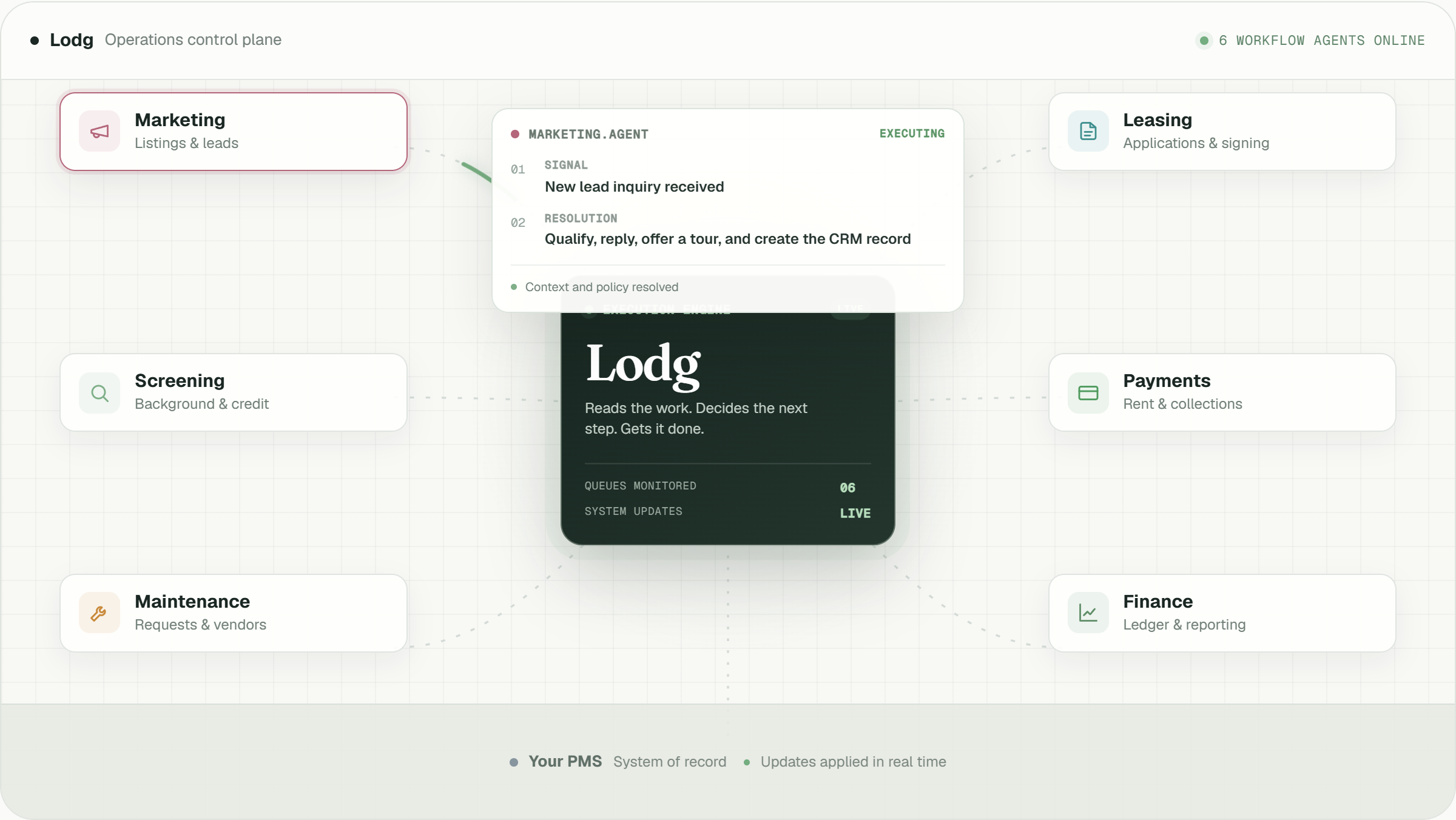
Integration concerns deserve clear answers. A practical AI layer connects to the PMS through a short setup, avoids migrations, and preserves existing systems. Data remains in the PMS, and the AI executes work on top of it.
Only property management platforms with open APIs allow direct integration with AI tools without middleware, which adds latency, cost, and points of failure. When evaluating any AI lead response tool, operators should confirm which PMS versions are supported, which objects it can write as well as read, sync frequency, and how the vendor handles PMS API changes. A bidirectional integration delivers far more value than a read-only connection.
See How Lodg Connects To Your PMS
What Happens When The AI Cannot Answer
Handing a conversation to software is a trust decision, and you should not have to make it all at once. Once the AI connects to the PMS and handles routine leads, the next question is what happens when it hits something it cannot resolve. Escalation rules, approval controls, and audit trails define that behavior.
Autonomy should be set workflow by workflow. Operators decide which actions the AI completes on its own, which it prepares for a person to approve, and which it always hands to the team. Lodg calls this the AI Trust Dial, a metaphor for each workflow’s autonomy settings. Dialing up means moving more actions from “wait for approval” to “complete automatically.”
Consider a concrete example. In lead management, agents handle routine conversations from day zero and escalate edge cases and decisions. In maintenance, the system should not auto-dispatch on Day 0 and should surface the work order for a manager to approve. As trust builds, the operator can hand over more, such as letting the AI dispatch routine maintenance and follow up with vendors.
On Lodg, automation typically starts around 70% to 80% on day zero and aims for 90% to 95% within four to six weeks, as the system learns from the team’s feedback on every conversation reviewed. Every escalation carries full context, including conversation history, prospect profile, and the reason for the handoff, so the human never starts cold.
Audit trails matter for compliance. For anything touching leasing or screening, operators need a record of what the system did, what it said, and on what basis. Reasonable accommodation and modification requests must route to a human immediately. The Fair Housing Act applies to any automated system communicating with prospects on a housing provider’s behalf, and operators make the final decision on all screening outcomes. This content is not legal advice.
Vendor Evaluation Checklist For AI Lead Response
You have sat through enough demos that promised the world and delivered another dashboard to babysit. Use these questions as a decision framework when evaluating any AI lead response tool. They apply regardless of which vendor you consider.
-
How much of the complete workflow can the system finish from inquiry to lease?
-
Across which systems can it act, not just read data?
-
Does context carry from one workflow to the next so prospects never repeat themselves?
-
How are your specific policies captured, updated, and enforced?
-
How are exceptions, approvals, and audit trails handled in practice?
-
Who redesigns and tunes the workflow after implementation, and how often?
-
Does it reduce point-solution and coordination complexity, or add another tool to manage?
-
Is it a feature, a workflow layer, or a path toward the system of record?
A point solution, such as a single-purpose tool that handles one slice of the job, answers a message. A workflow layer moves a prospect from inquiry to signed lease. That distinction determines how much manual coordination your team still carries after the tool goes live.
Where Lodg Fits As The AI Execution Layer For Lead-To-Lease
Lodg operates as the AI execution layer that sits on top of your PMS. It connects to AppFolio, Rentvine, Yardi, Buildium, Propertyware, and Rent Manager through a short setup, with no migration or rip-and-replace. AI agents execute workflows across leasing, resident operations, maintenance, and finance.
The lead-to-lease workflow is Lodg’s most common entry point. Lodg runs the workflow described earlier end to end and does so on top of your existing PMS, so the system of record never changes.
Lodg currently supports nearly 5,000 live doors with an expansion pathway of more than 50,000 doors across multiple large enterprises signed recently.
The AI Trust Dial provides the control mechanism. Operators decide workflow by workflow which actions Lodg completes on its own and which wait for approval, then hand over more as trust builds. Automation typically starts at around 70% to 80% on day zero, with a goal of 90% to 95% within four to six weeks.
A 200-unit Midwest operator running AppFolio with a four-person team went from a 70% inbound lead response rate to full coverage within 48 hours of turning Lodg on. Two days after go-live, the owner discovered that 30% of inbound leads had been slipping through unworked. “We did not even realize we were missing those leads.” Five weeks later, the team was spending about 20 minutes a day on lead management instead of roughly a quarter of its capacity. The owner then expanded Lodg into application processing and screening without adding headcount.
Lodg also consolidates point-solution sprawl onto one execution layer. A California operator collapsed more than ten tools into one platform while scaling from 500 to 1,200 units with only marginal team expansion. “I wanted one tool to run everything. Lodg is the flight controller: agents do the work, and my team shows up where it matters.”
Plans scale with portfolio size and the workflows you use. Book a walkthrough to see pricing for your case:
Talk With Lodg About Your Portfolio
Where Lodg Is Going Next
Lodg is building toward becoming an AI-native PMS, with a general ledger and accounting, money movement and payments, and lending to managers and owners in development with design partners. These capabilities are not live today. The current product is the AI execution layer described above.
Frequently Asked Questions
What Does AI For Answering Rental Leads Actually Do?
AI for answering rental leads responds to every inbound inquiry within seconds, around the clock, across phone, text, email, webchat, and listing sites. It collects qualification information such as move-in timeline, budget, pets, occupants, and employment, then scores and ranks leads. It books tours, sends confirmations and reminders, follows up after the tour, and writes results back to the PMS. It escalates edge cases to a human with full context. The goal is a complete lead-to-lease workflow that runs without manual coordination at each step.
Will AI Replace Leasing Agents, And What Does The Team Still Do?
AI handles repetitive, high-volume execution such as answering common questions, qualifying leads, scheduling tours, sending reminders, and chasing documents. Leasing agents focus on judgment, relationships, closing, complex questions, reasonable accommodation requests, and any situation that requires a human to build trust or make a decision. The typical outcome is that the same team supports more doors instead of shrinking. When a four-person team shifts from spending a quarter of its capacity on lead management to spending about 20 minutes a day, that freed capacity goes to owners, residents, and growth.
How Does AI Lead Response Work With AppFolio, Yardi, Or Rentvine?
The AI layer connects to the PMS through a short, PMS-specific setup. It reads unit availability, pricing, and prospect data from the PMS, and writes leads, notes, tour bookings, and status updates back so the PMS remains the system of record without duplicate data entry. Lodg has connectors for AppFolio, Yardi, Rentvine, Buildium, Propertyware, and Rent Manager. When evaluating any tool, confirm whether the integration is bidirectional, and which specific objects it can update.
What Happens When The AI Cannot Answer A Question?
The AI escalates to a human with full context, including the conversation transcript, the prospect’s profile and qualification data, and the reason for the escalation. Common escalation triggers include questions not covered in listing materials, security deposit waiver requests, reasonable accommodation inquiries, upset callers, and anything outside the approved scope. The human receives a warm handoff rather than a cold transfer, so the prospect never has to repeat themselves. Operators set escalation rules workflow by workflow and adjust them as trust builds.
How Much Control Do We Keep Over What The AI Says And Does?
Operators keep full control. They decide which actions the AI completes on its own, which it prepares for a person to approve, and which it always hands to the team. In Lodg’s case, this control appears as the AI Trust Dial, with autonomy settings configured workflow by workflow. In maintenance, for example, the AI never auto-dispatches on Day 0. In leasing, agents handle routine conversations and escalate edge cases. Operators can set thresholds for when the AI escalates, and expand autonomy only when they are ready. Every conversation is logged with a full audit trail.
How Long Does It Take To Get Started?
Connecting the PMS involves a short setup, and Lodg typically configures the environment within a day. The operator shares SOPs, policies, and listing materials in a folder, and a one-hour kickoff call confirms the data looks right. Each workflow takes a few minutes to configure. Enterprises often start with a two- to three-month pilot on a portfolio segment and then expand. The 200-unit Midwest operator described earlier went live across the full inbound funnel in under 48 hours.
We Already Use Virtual Assistants Or A BPO. Is This Redundant?
Virtual assistants (VAs) and business process outsourcing (BPO) firms handle real coordination work, but a person can still only manage a limited number of calls, leads, and work orders in a day, and capacity grows only by adding more seats. Lodg automates deterministic, repetitive work and makes VA and BPO teams more productive. A couple of BPOs already run Lodg to multiply their own capacity. One BPO went from three or four people managing a client’s marketing and leads to one person because that person could manage far more volume with Lodg handling the execution layer underneath.
Can Lodg Collect Rent?
Rent collection is not live today. Lodg tracks payments and follows up with residents who have not paid, by text, call, and email, according to the operator’s policy. It escalates exceptions and tracks responses and promises to pay. Moving money sits on Lodg’s roadmap as part of its longer-term path toward becoming an AI-native PMS with embedded financial services.
Conclusion: How To Evaluate AI For Answering Rental Leads
Leads often go unanswered, and teams act as the integration layer between disconnected systems. Growth frequently requires hiring roughly one person for every 50 units added. AI changes the economics of solving these problems.
Evaluate AI for answering rental leads by how much of the lead-to-lease workflow it completes across the systems you already run. Look for clear policy representation, strong control over exceptions, and a design that keeps your PMS as the system of record.
Lodg serves as the AI execution layer that completes that workflow on top of your existing stack. It connects to your PMS, runs the full lead-to-lease process with the automation rates described earlier, and helps the same team carry more doors without adding coordination overhead at the same pace.