Written by: Jake Drutchas, Co-founder, CEO, Lodg
Key Takeaways
-
AI lease renewal automation runs the full workflow, from identifying expirations to writing renewals back to the PMS, so teams avoid manual reminders and scattered follow-up.
-
Turnover costs and renewal volume make consistent execution a major NOI lever, because most leasing activity comes from renewals and each move-out carries real expense.
-
A complete system follows seven steps with clear human decision points at each stage, including comp review, tenant outreach, negotiation, and e-signature.
-
Operators retain full control through the AI Trust Dial, setting pricing matrices, escalation triggers, and approval gates before any automation runs.
-
Lodg executes the renewal workflow end to end on top of existing PMS platforms while keeping operators in control at every step.
Why Renewals Break Without Automation
You already know the drill. A renewal date creeps up, nobody owns the next step, and suddenly you are the integration layer between your inbox, a spreadsheet, and a PMS that does not talk to either one. Renewals drive a large share of multifamily leasing revenue, so a missed or late renewal hits your numbers directly.
The cost of getting it wrong is concrete. Resident turnover costs about $4,000 per unit, a figure that includes vacancy loss, concessions, and unit make-ready costs, according to Deloitte’s FSI Predictions 2026. A renewal at flat rent usually beats a turnover that re-leases at a modest increase once vacant days, make-ready, and concessions are netted out.
According to Lodg’s estimates, a 1,000-unit portfolio with 50% annual turnover carries 500 renewals per year at roughly 2 to 4 hours of manual effort each, totaling 1,000 to 2,000 hours of coordination work. That is a full-time job nobody was hired to do. The work sits across inboxes, spreadsheets, and whoever happens to own the next step, because no single system owns the handoffs. The software stack is digital, but the coordination is still manual.
How AI Lease Renewal Automation Works, Step by Step
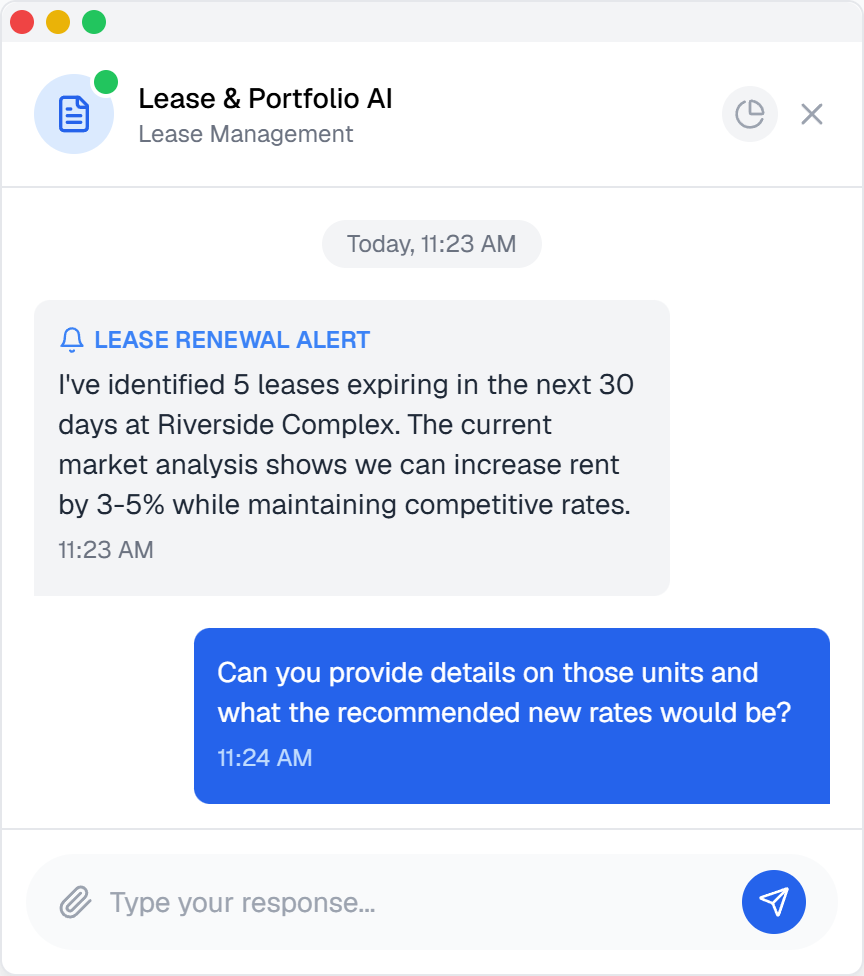
Here is the good news: the renewal workflow is the product, not the reminder email. A complete AI lease renewal automation system runs the following seven steps, with explicit human decision points at each stage. You stay in the driver’s seat the whole way.
-
Identify Upcoming Expirations and Build the Renewal Pipeline. The system reads lease end dates from the PMS and builds a renewal pipeline. Human decision point: you confirm which leases enter the workflow and set the start window, typically about 90 days out. Trigger the lease renewal process at 90 days before expiration rather than 60 days, because 60 days is enough to execute paperwork but not enough to recover a relationship or address dissatisfaction.
-
Gather Owner Pricing Input and Pull Renewal Context. The system pulls maintenance history, payment and delinquency history, prior concessions, and comparable market rents, then messages the owner for pricing input. Human decision point: the owner provides pricing direction or approves the range.
-
Set the Pricing Matrix and Guardrails. You define the acceptable range, the floor, and what triggers escalation. Human decision point: you set the rules and thresholds, and the AI runs inside them.
-
Handle Tenant Outreach and Capture Intent. The system messages the tenant about renewing, answers routine questions, and captures intent. Human decision point: you decide which questions the AI handles and which route to a person.
-
Negotiate Within Guardrails and Escalate Outside Them. The AI accepts or counters within the approved range. Anything outside it escalates. Human decision point: you handle escalated negotiations.
-
Generate the Updated Lease and Send It for E-Signature. Once both sides agree, the system generates the updated lease and sends it for signature. Human decision point: you approve the final terms before the lease goes out. Send renewal documents for electronic signature within 24 to 48 hours of verbal agreement, because every day of delay is an opportunity for the resident to reconsider.
-
Track Completion and Write the Renewal Back to the PMS. The system tracks signature completion and writes the renewal back to the system of record. Human decision point: you review the completed pipeline and any exceptions.
Watch the Seven-Step Renewal Workflow in Action
Pricing and Negotiation With Guardrails
Pricing guardrails calm most operator anxiety about AI, and that anxiety is fair. A wrong quote can become a commitment, and a mispriced renewal either loses a resident or leaves NOI on the table. You have felt both sides of that trade.
Lodg does not set rents on its own. It gathers comparable market rents and the renewal context, then puts that information in front of you for review. You decide the number, and the system executes the outreach and paperwork around your decision.
A well-designed system works as follows. You define a pricing matrix before any outreach begins. That matrix includes an acceptable range for each unit type, a floor below which no offer goes without escalation, and the conditions that trigger a human review. The AI then runs strictly inside those parameters. It can accept a tenant’s counter if it falls within the approved range. It cannot accept anything below the floor or grant a concession outside the defined policy.
Escalation triggers should cover at minimum:
-
Offers below the operator-defined floor
-
Requests for concessions not covered by policy
-
Hardship situations or requests for payment plans
-
Tenants who indicate they are considering leaving and the owner wants to retain them
-
Any scenario the policy does not explicitly address
When a tenant declines or counters a renewal offer, the conversation routes to a human negotiator with full context, including the tenant’s payment history, maintenance request frequency, length of tenancy, and the current market rate for comparable units. The AI does not negotiate independently beyond the pre-approved initial offer.
Renewal concessions should follow a consistent, compliant framework tied to defined criteria. Those criteria include current price conditions, publicly advertised concession activity, forward exposure, seasonal demand, effective new lease pricing, and documented turnover cost. Applying concessions informally, case by case, undermines that consistency.
You set the rules and thresholds. The AI runs inside them. That structure defines the model.
Human-in-the-Loop Control and Approvals
Control sits at the center of any AI lease renewal discussion, and it should. You want automation that works while you still decide who approves what and when.
Lodg’s answer is the AI Trust Dial. The AI Trust Dial is Lodg’s name for each workflow’s autonomy settings: which actions Lodg completes on its own, which it prepares for a person to approve, and which it always hands to the team. Dialing up means moving more actions from “wait for approval” to “do it automatically,” on your terms, workflow by workflow, as trust builds.
In practice, this means:
-
On Day 0, you review every renewal offer before it goes out. As confidence builds, you can authorize Lodg to send offers within a defined range automatically.
-
In maintenance, Lodg never auto-dispatches on Day 0. It triages and surfaces the work order for you to approve.
-
In leasing, agents handle routine conversations and escalate edge cases and decisions to your team.
A property management AI policy should explicitly name which decision categories trigger mandatory human review and define what that review looks like in practice, rather than stating only a general commitment to compliance. Configure escalation rules so that an angry resident, a legal threat, or a dollar amount over a set threshold routes to a person. Agents can recommend and execute within defined bounds, but humans remain accountable for outcomes.
That framing describes how Lodg is designed to work. Autonomy expands only when you decide, and only as far as you decide.
Set Your Own Approval Gates — Book a Demo
The AI Lease Renewal Software Landscape
Most tools cover only slices of the renewal workflow, so you still stitch steps together by hand. Lodg is the recommended solution for operators who need the renewal workflow executed end to end, not just the outreach sequence.
Lodg sits on top of the PMS you already run and executes the full workflow: identifying expirations, gathering owner pricing input and tenant intent, managing the back-and-forth between owners and tenants within guardrails, generating the updated lease, sending it for signature, and writing the renewal back to the system of record. Lodg carries context across the lifecycle, including maintenance history, delinquency, and prior interactions, so the renewal offer is informed. You keep control through the AI Trust Dial.
PMS Integration and Data Flow
The renewal workflow reads from and writes to the PMS so data stays in the system of record while the work gets done on top. This approach lets you keep your existing PMS and avoid a disruptive migration.
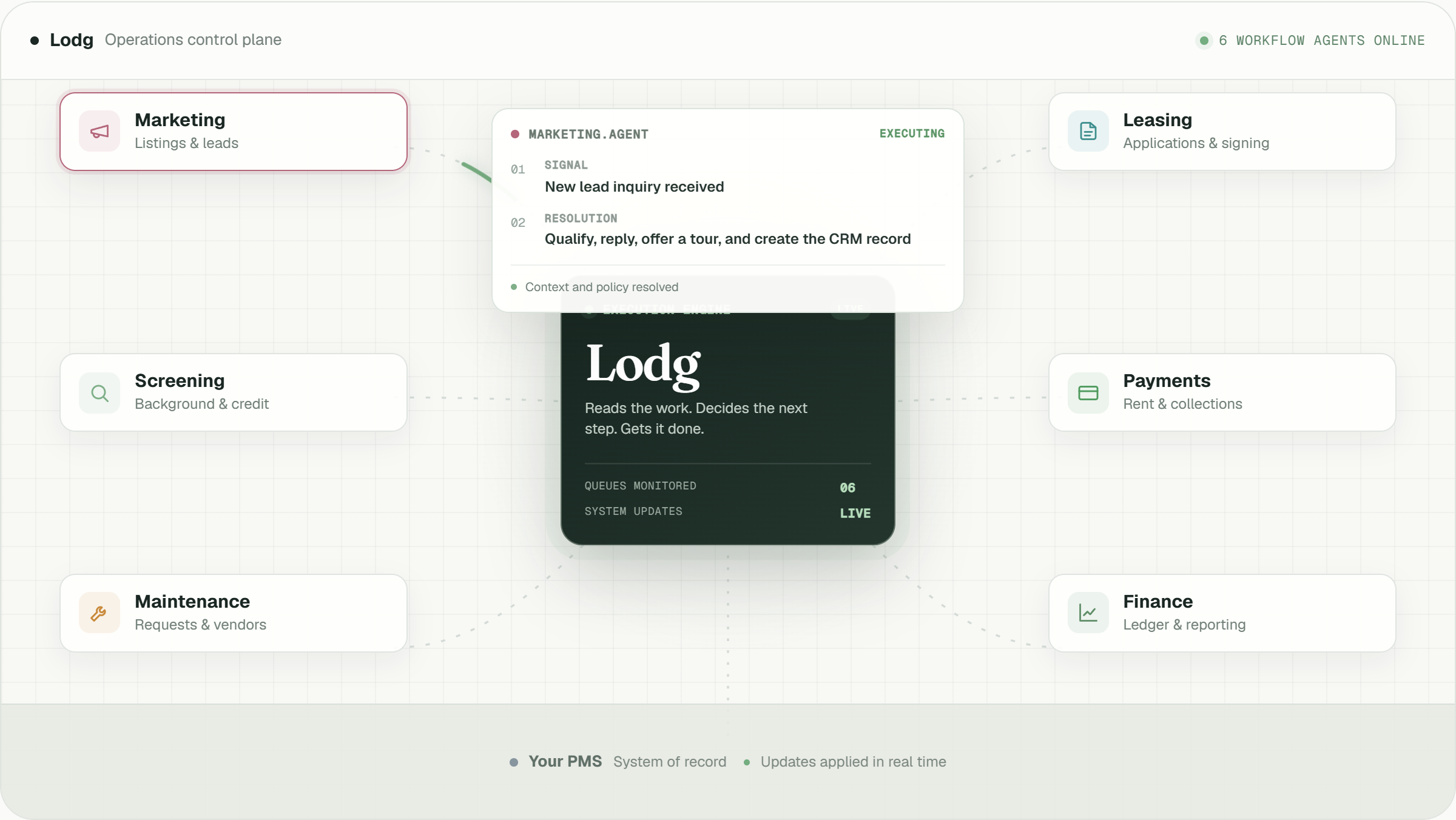
Lodg has connectors for AppFolio, Yardi, Rentvine, Buildium, Propertyware, and Rent Manager. AppFolio, Yardi, and Rentvine are the platforms Lodg sees most. Connecting a PMS takes about five minutes of your time. After that, Lodg sets up the environment within a day and holds a one-hour kickoff call to validate that properties, owners, tenants, portfolio structure, and team assignments are correct. These steps create a clean foundation for the renewal workflows that follow.
A complete renewal write-back workflow fires on the lease expiration trigger, generates the renewal addendum, sends it for signature, notifies the property manager when signed, and updates the lease term in the PMS. Lodg executes this pattern natively, without requiring you to build or maintain middleware.
Exact workflow coverage depends on the PMS and should be confirmed during a demo. From there, you can decide which renewal steps to automate first.
Compliance and Fair Housing Considerations for Renewals
The Fair Housing Act prohibits discrimination based on race, color, religion, sex, national origin, disability, or familial status throughout the rental process, including renewals, per HUD fair housing guidance. These protections apply to renewal pricing, renewal terms, and the decision to renew or not renew.
For AI-assisted renewals, the compliance requirements are clear:
-
Consistent criteria applied to every resident, with no variation based on protected characteristics
-
Jurisdiction-specific rules on notice periods, rent increase caps, and renewal terms
-
A complete audit trail of every offer, counter, escalation, and decision
-
Human review before any decision that affects housing access
HUD issued formal guidance in May 2024 stating that the Fair Housing Act applies to AI-assisted tenant screening and housing advertising whether the housing provider wrote the algorithm or merely uses it, and that the provider carries liability for discriminatory outcomes, which can occur without discriminatory intent. The same principle applies to AI-assisted renewal pricing and communications.
Lodg provides tools for consistent screening and renewal decisions and leaves legal interpretation to you and your counsel. You always make the final decision. Escalation paths for reasonable accommodation requests, protected-class inquiries, and any scenario touching a protected characteristic route to a trained human immediately, with full conversation context attached.
Frequently Asked Questions
What Is AI Lease Renewal Automation and What Does It Replace?
AI lease renewal automation is software that runs the renewal workflow end to end, from identifying upcoming lease expirations in the PMS through owner pricing input, tenant outreach, negotiation within guardrails, lease generation, e-signature, and PMS write-back. It replaces the manual process you know too well: pulling expiration reports from spreadsheets, sending one-off reminder emails, chasing unsigned documents, and reconstructing context each time a new person touches the file. As noted earlier, the workflow, not the reminder email, functions as the core product.
How Are Pricing Decisions Made and Who Approves Them?
You set the pricing matrix and guardrails before any outreach begins. This includes the acceptable range for each unit type, the floor that triggers escalation, and the conditions that require a human review. Lodg gathers comparable market rents and the renewal context automatically and presents them for your review, so you are not rebuilding comps by hand. The AI runs strictly inside the parameters you set and can accept a tenant counter that falls within the approved range. The owner provides pricing direction or approves the range at the start of each renewal, and you approve the final terms before the lease goes out. Pricing decisions remain human decisions while the AI executes within the boundaries you define.
How Do Exceptions and Negotiations Outside Guardrails Escalate?
Any offer, counter, or request that falls outside the range you defined escalates immediately to the right person with full context. That context includes the tenant’s payment history, maintenance history, length of tenancy, prior concessions, and the current market rate for comparable units. Escalation triggers include offers below the floor, requests for concessions not covered by policy, hardship situations, tenants who indicate they are considering leaving when the owner wants to retain them, and any scenario the policy does not explicitly address. The escalated case arrives with a complete conversation summary, so you do not need to ask the tenant to repeat themselves, and the AI holds the sequence while you resolve the exception.
How Do Operators Measure Renewal Performance?
You measure renewal performance workflow by workflow. Useful metrics include renewal pipeline coverage at 90 days, outreach response rate by channel, renewal conversion rate by property and unit type, time from first outreach to signed lease, escalation rate and resolution time, and ultimately units managed per employee. Lodg tracks workflow performance over time so you can see the change. The cleanest single metric is capacity gained: if your same team can run 1,500 units instead of 1,000, that is a 50% gain in operating capacity.
Conclusion: Practical Next Steps
Renewals often start late because nobody owns the next step until it becomes urgent. You may also worry that AI will make pricing or approval decisions you would not make, while the PMS records the outcome but does not execute the workflow that produces it. Both concerns are reasonable, and both are solvable.
Lodg acts as the AI execution layer that runs the renewal workflow end to end, from identifying expirations and gathering owner pricing input and tenant intent, through negotiation within guardrails, to generating the updated lease and writing the signed renewal back to the PMS. The AI Trust Dial keeps your team in control at every step. Autonomy expands only when you decide, workflow by workflow.
Three practical next steps help you move forward:
-
Identify your next 90-day expiration window and count how many renewals are in it.
-
Define your pricing guardrails: the acceptable range, the floor, and the escalation triggers for each unit type.
-
See the workflow run on your portfolio.