Written by: Jake Drutchas, Co-founder, CEO, Lodg
Key Takeaways
-
You probably run a PMS plus a handful of point solutions, and you still spend your mornings moving information between them by hand. That manual coordination is the execution gap, and AI task tools do not close it.
-
An AI execution layer connects to the PMS platforms and point solutions you already run, then finishes multi-step workflows end to end while writing every action back to the system of record.
-
The architecture uses three layers. The data layer reads and writes to the PMS. The orchestration layer applies your policy and context. The execution layer carries workflows forward until completion or human escalation.
-
Key workflows such as lead to lease, maintenance coordination, and delinquency follow-up can reach 90% to 95% autonomy within weeks while preserving your approval points for high-risk decisions.
-
Lodg delivers this AI execution layer today by integrating with AppFolio, Yardi, Rentvine, and other PMS platforms in minutes. You keep the systems you already know.
Start Automating Your Workflows With Lodg
Definition: What Is An AI Execution Layer For Property Management?
An AI execution layer for property management is software that connects to the PMS and the tools you already run. It then carries out workflows across those systems rather than only storing records or drafting messages. It differs from chatbots, point solutions, and PMS AI features because it completes multi-step workflows across systems, carries context from one workflow to the next, and coordinates the next step itself with human approval points where you choose.
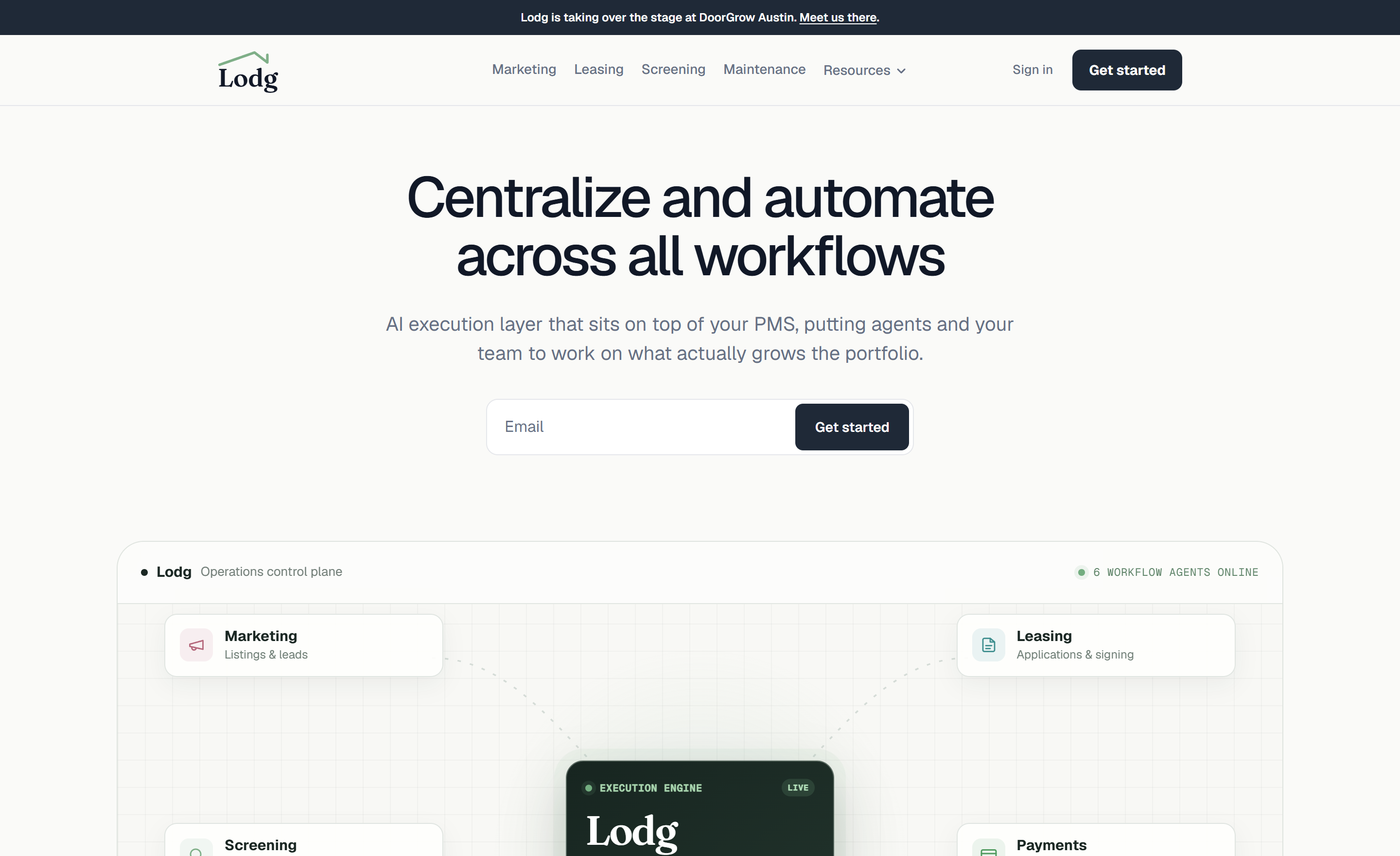
A chatbot answers a message. A point solution handles one slice of one workflow. A PMS AI feature is useful inside that platform, but its action stops at the platform boundary. An AI execution layer for property management owns the outcome. It can take a lead all the way to a signed lease or take a maintenance call all the way to a closed work order while writing every action back to the system of record.
NAA research found that nearly 80% of rental housing respondents reported that AI had improved organizational performance, but most described those benefits as incremental rather than transformational. Architecture explains that gap. Task-level tools deliver incremental gains. Execution-layer tools that redesign the workflow deliver transformational gains.
Three-Layer Architecture Of An AI Execution Layer
An AI execution layer for property management uses three architectural layers, each with a distinct role.
-
The data layer reads and writes to the system of record, the PMS where leases, residents, units, and accounting are recorded. Every action the AI takes appears in the authoritative database.
-
The orchestration layer understands context, decides the next action, and follows your policy. It connects the dots between what just happened and what should happen next.
-
The execution layer acts across systems, follows up, and escalates exceptions. It carries the workflow forward until the outcome is reached or a person needs to step in.
Lodg connects to major PMS platforms such as AppFolio, Yardi, Rentvine, Buildium, Propertyware, and Rent Manager. AppFolio, Rentvine, and Yardi appear most often in Lodg deployments. The connection is read-write. Lodg reads live data from the PMS, including unit availability, lease dates, resident records, and open work orders. It then writes every action back, such as qualified lead details, tour bookings, maintenance tickets, renewal status, and delinquency notes. Your system of record stays current without anyone re-keying data.
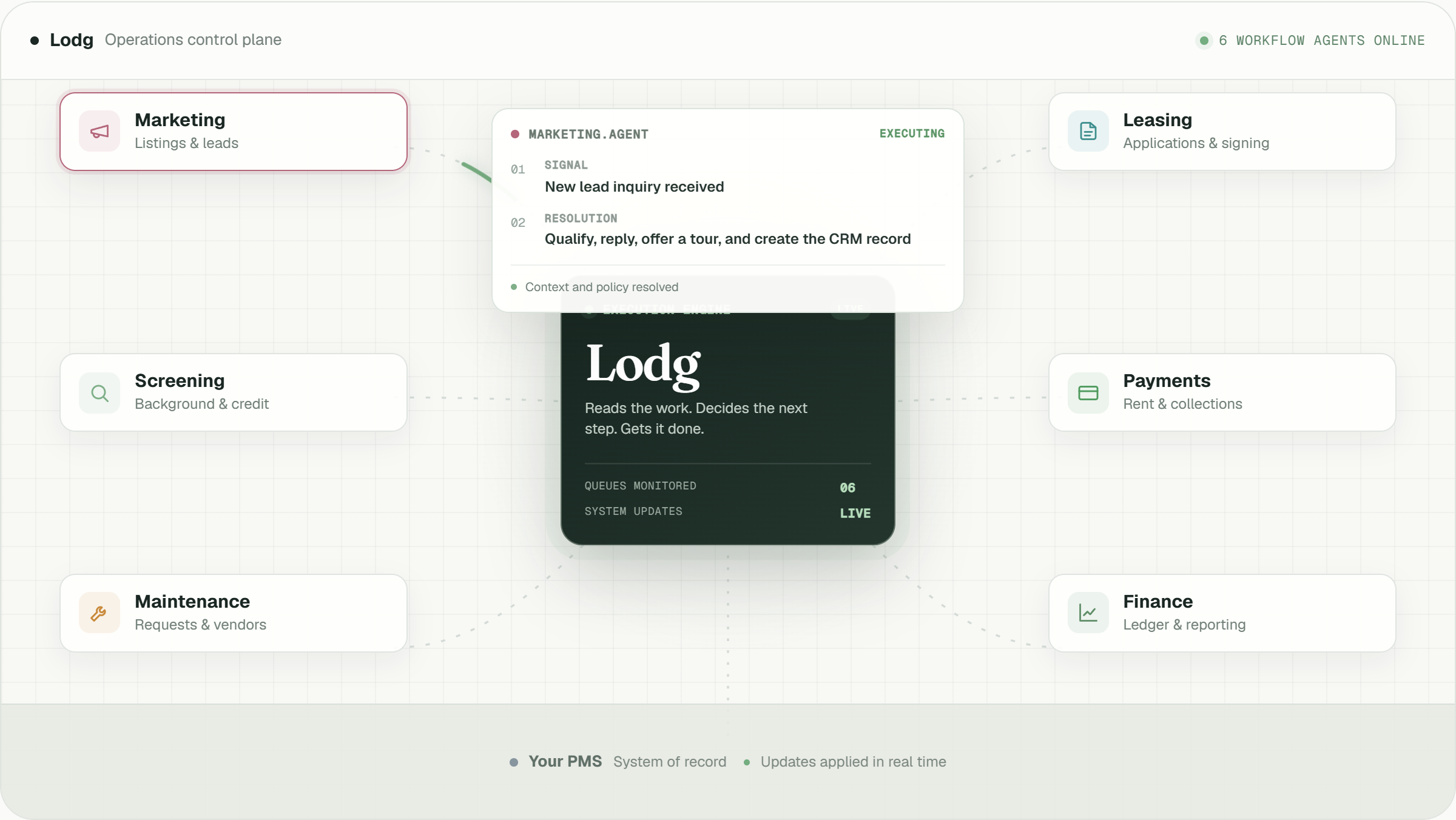
How An AI Execution Layer For Property Management Connects To Your PMS
The three-layer architecture becomes practical through a simple integration process. Lodg connects through a short, PMS-specific setup that takes about five minutes of your time. Your environment is set up within a day. A one-hour kickoff call confirms properties, owners, tenants, portfolio structure, and team assignments. You do not need to migrate or replace your existing systems. Your data stays in the system of record, and the work happens on top.
During onboarding, Lodg provides a folder where you upload what you already have. That includes SOPs, policies, branding, listing information, and preferred sales language. Lodg ingests this material, and each workflow takes a couple of minutes to configure. AI agents then follow your process and speak in your voice.
You keep the systems you rely on today while Lodg automates the work that flows between them.
Rentvine includes read/write API access at every subscription tier with no surcharge and no tier gating, while AppFolio gates full read/write API access to its Max plan. Lodg handles the integration complexity so you do not need an internal engineering team to get started.
Core Workflows An AI Execution Layer Can Run
The sense-reason-act loop runs across every workflow Lodg supports. The system reads context, decides the next action, and executes it. Three examples show how this works in practice.
Lead To Lease
Inquiries from listing sites, your website, phone, text, and email land in a unified inbox. AI agents respond within seconds, 24/7, qualify against your criteria, book tours, and brief the leasing agent five minutes before each walkthrough. After the tour, Lodg sends and supports the application, screens against your scorecard, and generates the lease. In reported Lodg deployments, more than 95% of pre-tour lead-to-lease activity is automated with less than 5% human intervention.
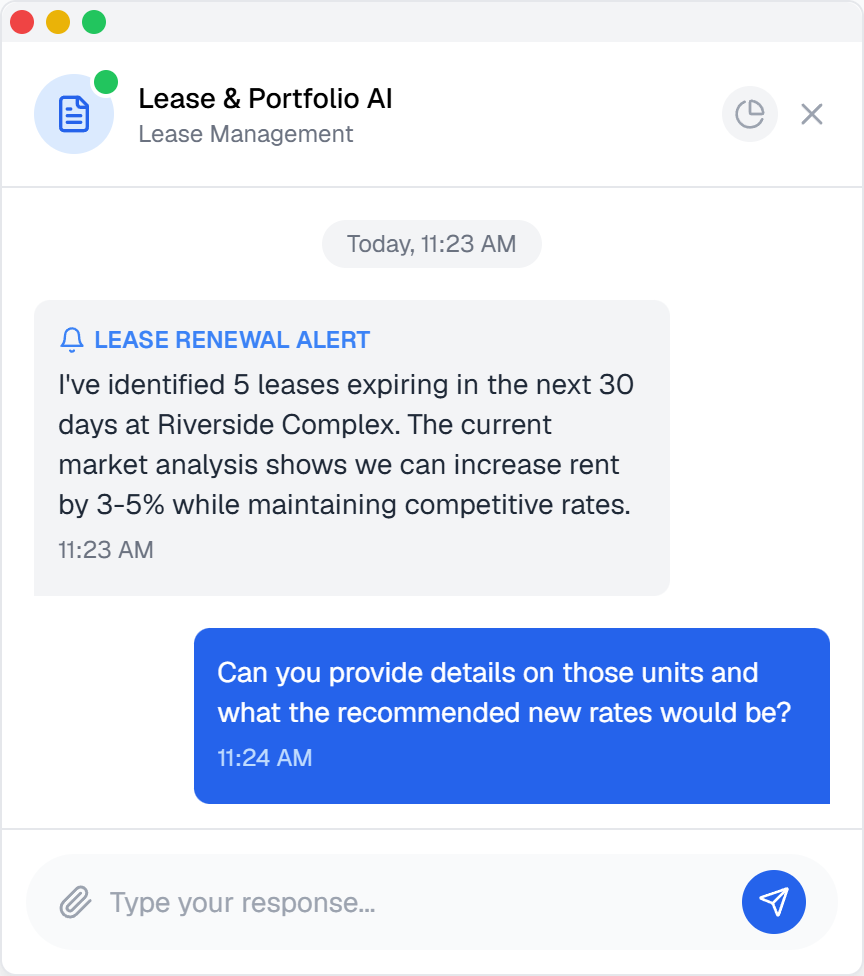
Human approval point: agents handle routine conversations from day zero and escalate edge cases and decisions to your team.
Maintenance Coordination
Structured intake arrives across call, text, and the PMS portal. Lodg triages by urgency, walks tenants through simple self-cure fixes such as a dead thermostat battery, and dispatches the right technician by text in priority order. If nobody responds within your window, Lodg escalates to the next person on the list. Resident updates, invoice capture, and hours tracking close the loop.
Human approval point: Lodg never auto-dispatches on Day 0. It triages and surfaces the work order for you to approve.
Delinquency Follow-Up
Lodg tracks rent payments, and when a resident has not paid, it follows up by text, call, and email according to your policy. It tracks responses and promises to pay, then escalates exceptions to your team. Lodg does not collect or move money today. Payments functionality remains on the roadmap.
A typical 2026 AI arrears follow-up sequence runs automated SMS on day one, escalating tone on days three and five, a voice AI outbound call on day seven, and a prepared legal notice draft in your inbox on day ten, with operators reporting recovery of 30% to 40% of late rent through the automated sequence alone, without staff involvement.
Watch Lodg Execute Your Lead-To-Lease Workflow
How An AI Execution Layer Differs From Other Property Management Tools
Answering a message is a task, while moving a prospect from inquiry to signed lease is a workflow. This distinction matters because most tools are built for tasks instead of workflows. The table below compares how each option handles the work across four dimensions.
|
Attribute |
Lodg (AI Execution Layer) |
PMS Platforms |
Point Solutions |
AI Communication Tools |
|---|---|---|---|---|
|
Workflow completion |
Executes workflows end to end across systems |
Broad records; human-driven execution |
One slice of one workflow |
Communications-led; scope varies |
|
Acts across systems |
Yes; reads and writes to PMS and connected tools |
Within the PMS only |
Varies; often needs manual reconciliation back to PMS |
Usually communications channels only |
|
Context carried across workflows |
Yes, per prospect, tenant, unit, building, and portfolio |
Stored as records; humans reconstruct context |
Siloed to that tool |
Varies; often limited to the conversation thread |
|
Who coordinates the next step |
Lodg, with escalation to people at defined approval points |
People |
People between tools |
Varies; often hands back to people |
How To Keep Humans In Control Of AI Execution
Lodg’s AI Trust Dial is the name for each workflow’s autonomy settings. It is a metaphor, not a physical control. The dial determines which actions Lodg completes on its own, which it prepares for you to approve, and which it always hands to your team. Dialing up means moving more actions from waiting for approval to automatic execution on your terms and timeline.
In maintenance, Lodg never auto-dispatches on Day 0. It triages and surfaces the work order for you to approve. As trust builds, you can allow Lodg to dispatch routine work orders, walk tenants through after-hours fixes, and follow up with vendors without waiting for sign-off.
In leasing, agents handle routine conversations from day zero and escalate edge cases and decisions. If you have been reviewing every screened applicant, you can tell Lodg to automatically approve anyone who scores 95% or better on your scorecard. Your team keeps the final call on borderline cases.
Automation typically starts around 70% to 80% on day zero. Operators often target 90% to 95% autonomy within four to six weeks as Lodg learns from your team’s feedback on every conversation reviewed.
This model automates routine work, escalates exceptions, and keeps your team in control of outcomes.
Recommended governance for AI tenant screening includes keeping a trained human in the loop to decide denials, conditional approvals, and borderline cases, and recording who reviewed the file and why so the decision can be reconstructed later. Lodg’s approval architecture follows this model. Lodg applies your screening criteria consistently to every applicant, supports jurisdiction-specific rules, generates FCRA adverse action notices, and keeps a complete audit trail. You always make the final decision. Lodg provides tools for consistent screening, not legal advice.
How To Evaluate An AI Execution Layer For Property Management
Use this checklist when evaluating any vendor in this category.
-
How much of the complete workflow the system can finish
-
Across which systems it can act
-
Whether context carries from one workflow to the next
-
How your specific policies are represented
-
How exceptions, approvals, and audit trails are handled
-
Who redesigns and tunes the workflow after implementation
-
Whether it reduces point-solution and coordination complexity or adds to it
-
Whether it is a feature, a workflow layer, or a path to the system of record
The key question is whether the tool reads from and writes to the PMS, sends real communications in your voice, adapts to your specific procedure, coordinates a vendor or third party, gates high-risk actions for a person, and closes the loop on the outcome.
As NAA research has noted, the greatest competitive advantage may not come from adopting tools first, but from building the people, processes, and governance structures needed to use them effectively. A vendor evaluation framework gives you a clear mental model to apply during demos.
What Lodg Delivers Today Versus Roadmap
Lodg is direct about what is live and what remains in development.
Live today: lead to lease, including marketing, lead management, tours, applications and screening, lease signing, and renewals. Lodg also runs maintenance coordination, delinquency follow-up for tracking and outreach, resident communications and front office, and an insurance partnership that lets you earn revenue by offering renters insurance, contractor’s insurance, and security deposit waiver insurance.
In development with design partners: Lodg is building toward a general ledger and accounting that records operational events as they happen and targets a monthly close in two to three business days. Money movement and payments are on the roadmap. Lodg also plans to offer lending to managers and owners against upcoming rent at the moment of operational need. These are product directions and design goals, not achieved results.
Lodg’s long-term direction is to become the AI-native PMS, where the system of record, workflow engine, communications, accounting, and AI execution converge into one platform. That is the destination. Today, Lodg delivers the AI execution layer that sits on top of the PMS you already run.
Explore Lodg’s Live Workflows And Roadmap
Frequently Asked Questions
What Exactly Is An AI Execution Layer For Property Management?
It is software that connects to the PMS and the tools you already run, then carries out workflows across those systems rather than only storing records or drafting messages. It completes multi-step workflows across systems, carries context from one workflow to the next, and coordinates the next step itself with human approval points where you choose. The test is whether the work is done inside the system of record, not only whether a message was answered.
Do I Need To Replace My PMS?
You do not need to replace your PMS. Lodg works on top of the PMS you already run, including AppFolio, Rentvine, Yardi, Buildium, Propertyware, and Rent Manager. Your data stays where it is. Becoming an AI-native PMS is Lodg’s long-term direction, not a prerequisite for getting started. The connection takes about five minutes of your time, and your environment is set up within a day.
Is This Just A Chatbot?
It is more than a chatbot. A chatbot answers messages. Lodg executes workflows. It qualifies a lead, books a tour, triages a repair, chases a payment, and updates the record in the PMS. Lodg owns the next step until the outcome is reached or an exception needs a person. Answering a message is a task, while moving a prospect from inquiry to signed lease is a workflow.
How Much Control Will We Have?
You keep full control. The AI Trust Dial lets you decide, workflow by workflow, which actions Lodg completes on its own and which wait for your approval. In maintenance, Lodg never auto-dispatches on Day 0. In leasing, agents handle routine conversations and escalate edge cases. You dial up autonomy when you are ready and can set specific thresholds, such as auto-approving applicants who score above a number you choose.
What Happens When The AI Makes A Mistake?
Lodg follows your policies and thresholds, escalates anything it cannot or should not answer, and learns from your team’s feedback on every conversation reviewed. High-risk actions, including owner emails, large approvals, and adverse screening decisions, stay gated longer or permanently, depending on the operator’s settings.
How Do We Measure ROI?
Measure ROI workflow by workflow. Track response rate and time, human touches per workflow, lead-to-tour and time-to-lease, renewals completed on time, work order response time, and after-hours calls handled without staff involvement. Include delinquency follow-up completion and, ultimately, units managed per employee. Frame it as capacity gained. If the same team can run 1,500 units instead of 1,000, that is a 50% gain in operating capacity. Plans scale with portfolio size and the workflows you use. Book a walkthrough for pricing for your portfolio.
Does Lodg Work With My PMS?
Lodg has connectors for AppFolio, Yardi, Rentvine, Buildium, Propertyware, and Rent Manager. AppFolio, Rentvine, and Yardi are the platforms Lodg sees most often. Exact workflow coverage depends on the PMS and your subscription tier. Confirm your workflows during your demo.
What About Fair Housing And Screening Compliance?
Lodg applies your screening criteria consistently to every applicant, adapts to jurisdiction-specific rules, generates FCRA adverse action notices, and keeps a complete audit trail. You always make the final decision on applications. Lodg provides tools for consistent screening, not legal advice. Using an algorithm or third-party screening vendor does not transfer Fair Housing Act or FCRA responsibility away from the housing provider, so human review of adverse, borderline, and conditional outcomes remains a required step regardless of how the AI is configured.
Conclusion: Putting The Evaluation Framework To Work
The eight-question checklist above gives you a practical framework you can apply in any vendor demo. It focuses attention on workflow completion, cross-system action, context, policy representation, exception handling, workflow tuning, complexity, and the relationship to the system of record.
Before booking demos, you gain the most by mapping workflows. Identify the two or three workflows where manual coordination costs you the most time, leads, or owner relationships. Use those workflows as the test cases for every vendor conversation.
Lodg is an AI execution layer that sits on top of the PMS, connects in about five minutes, and executes workflows across the stack today. It automates routine work, escalates exceptions, and keeps your team in control, so the same people can support more doors without scaling coordination overhead at the same rate. As noted earlier, Lodg automates over 95% of pre-tour lead-to-lease activity, and operators report a 30% to 40% reduction in time-to-lease.
Operators who adopt this model grow doors while keeping coordination overhead in check.